
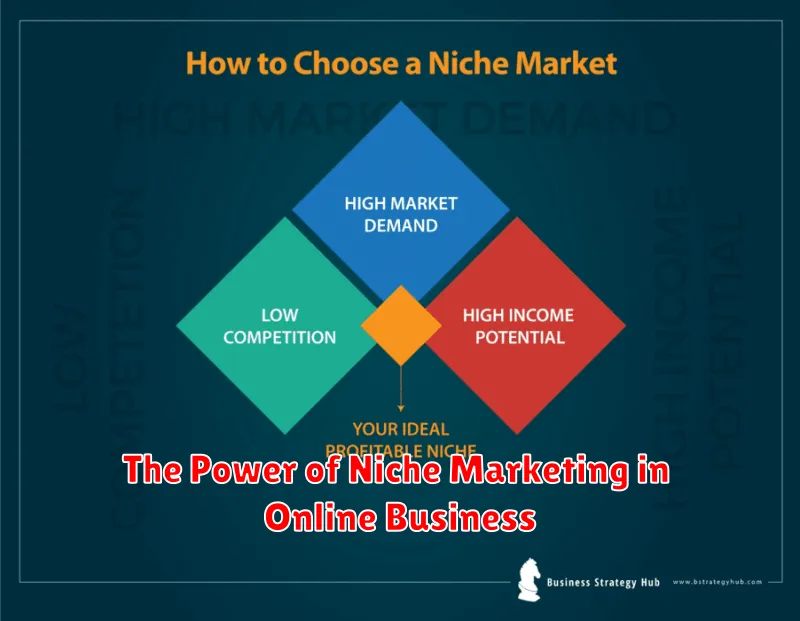
In today’s competitive digital landscape, niche marketing has emerged as a powerful strategy for online businesses seeking to thrive. Instead of casting a wide net and hoping for the best, niche marketing focuses on targeting a specific, well-defined segment of the market. This approach allows businesses to connect with a highly engaged audience who are actively seeking solutions within that particular niche. By understanding the unique needs, preferences, and pain points of their target audience, businesses can tailor their products, services, and marketing messages for maximum impact. Niche marketing offers significant advantages, including reduced competition, increased customer loyalty, and higher conversion rates. This strategic approach is essential for online businesses seeking to establish a strong brand presence and achieve sustainable growth in the digital age.
This article will explore the power of niche marketing in driving online business success. We will delve into the core principles of effective niche selection, target audience identification, and the development of tailored marketing strategies. Discover how focusing on a niche can unlock unprecedented opportunities for growth, increased profitability, and a stronger connection with your ideal customer. Learn how to harness the power of niche marketing to differentiate your business, build a loyal customer base, and achieve long-term success in the competitive online marketplace.
Why Targeting a Niche Beats Mass Appeal
In today’s saturated market, attempting to appeal to everyone often leads to appealing to no one. Niche marketing, on the other hand, focuses on a specific segment of the market with distinct needs and preferences. This targeted approach allows businesses to tailor their messaging, product development, and marketing efforts to resonate deeply with a smaller, yet highly engaged, audience. By understanding the nuances of their niche, businesses can establish themselves as experts and build stronger customer loyalty, leading to higher conversion rates and increased profitability.
Mass appeal strategies often involve significant marketing expenditure spread across a wide range of channels, leading to diluted impact and lower returns. Niche marketing allows for more cost-effective strategies, as resources can be concentrated on reaching the specific target audience through relevant channels. This precision not only saves money but also fosters a stronger sense of community and belonging within the niche, leading to increased word-of-mouth marketing and organic growth.
Ultimately, while mass appeal might seem attractive in its breadth, niche marketing offers the competitive advantage of focused expertise and deeper customer relationships. This targeted approach fosters brand loyalty, increases profitability, and allows businesses to thrive in a crowded marketplace by truly owning their space.
Finding the Right Niche for Your Skills

Identifying the right niche for your skills requires careful self-assessment and market research. Begin by honestly evaluating your strengths and weaknesses. Consider what you enjoy doing and what you excel at. Then, research industries and markets where those skills are in demand. Look for areas where you can offer something unique or where there’s a gap you can fill. This intersection of your abilities and market needs is a potential niche.
Once you’ve identified a few potential niches, analyze the competition. Understanding your competitors’ strengths and weaknesses will help you refine your own offering and identify opportunities to differentiate yourself. Consider factors such as pricing, marketing strategies, and target audience. This analysis will help you determine the viability and profitability of each niche.
Finally, test your niche. Before fully committing, experiment with different approaches to see what resonates with your target audience. This could involve offering a limited-time promotion, launching a small-scale project, or gathering feedback from potential customers. This testing phase allows you to refine your strategy and ensure you’ve chosen a niche that aligns with your skills and offers a real market opportunity.
Audience Profiling and Pain Points
Audience profiling is the process of defining distinct groups of consumers based on shared characteristics, such as demographics, psychographics, buying behaviors, and needs. This allows businesses to target their marketing efforts more effectively by tailoring messages and offers to resonate with specific audience segments. Accurate audience profiling leads to increased campaign effectiveness, reduced marketing costs, and a better understanding of the customer base.
Pain points represent specific problems, challenges, or frustrations that a target audience experiences. Identifying these pain points is crucial for developing products, services, and marketing messages that address these issues directly. By understanding what problems your audience faces, you can position your offerings as solutions and demonstrate the value you provide. Examples of pain points can include anything from inefficient processes and high costs to a lack of information or difficulty finding desired products.
By combining audience profiling with pain point identification, businesses can achieve a highly focused approach to marketing and product development. Understanding both who your target audience is and what their challenges are allows for the creation of more effective campaigns that resonate deeply with the right people, ultimately driving engagement and conversions. This combined approach fosters a stronger connection with the customer base by demonstrating a genuine understanding of their needs and providing tailored solutions.
Creating Specific and Relevant Content
Creating specific and relevant content is crucial for effective communication. Specificity ensures that the information provided is precise and unambiguous, directly addressing the topic at hand without unnecessary digressions. Relevance, on the other hand, guarantees that the content aligns with the audience’s needs and interests, making it engaging and valuable. By focusing on these two key aspects, content creators can ensure that their message is clearly understood and resonates with the intended recipients.
To achieve specificity, use concrete examples, precise language, and actionable advice. Avoid generalizations and jargon that may confuse the audience. Instead, opt for clear and concise wording that leaves no room for misinterpretation. This targeted approach enables readers to grasp the core message quickly and efficiently.
Maintaining relevance requires a deep understanding of the target audience. Consider their existing knowledge, their pain points, and their desired outcomes. By tailoring the content to meet these specific needs, you can ensure that it is not only informative but also useful and impactful.
SEO Benefits of Niche Focus

A niche focus offers several significant SEO advantages. By concentrating your content and keyword strategy on a specific area, you reduce competition against larger, more generalized websites. This allows you to target long-tail keywords – longer, more specific search phrases – that have less competition but higher conversion rates. Essentially, you’re becoming the go-to resource for a particular audience, attracting highly qualified traffic that is more likely to convert into customers or clients.
Niche focus also improves your website’s topical authority. Search engines reward sites that demonstrate expertise and depth of knowledge within a specific subject. By consistently producing high-quality, relevant content within your niche, you build trust and authority in the eyes of search engines, leading to higher rankings and increased visibility in search results.
Focusing on a niche helps streamline your content marketing efforts. It’s easier to identify relevant topics, conduct keyword research, and create content that resonates with your target audience. This targeted approach results in a more cohesive and effective content strategy, driving organic traffic and establishing your brand as a leader in your niche.
Niche Product or Service Positioning
Niche product or service positioning focuses on a specific, underserved segment of the market. Instead of trying to appeal to everyone, a niche business concentrates its marketing efforts on a distinct group with particular needs, preferences, or demographics. This allows for highly targeted messaging and the development of products or services that precisely address the unique requirements of the chosen niche.
Benefits of niche positioning include reduced competition, increased customer loyalty, and potentially higher profit margins. By specializing, businesses can become experts in their niche and build a strong reputation for meeting the specific needs of their target audience. This focused approach can lead to a stronger brand identity and a more loyal customer base compared to businesses operating in broader, more competitive markets.
Identifying a profitable niche requires careful market research and analysis. Consider factors such as market size, growth potential, competition, and profitability. Look for areas where current market offerings fall short of meeting customer needs. This may involve focusing on a specific demographic, a unique product feature, or a particular geographical area. By carefully selecting and serving a well-defined niche, businesses can establish a strong market position and achieve sustainable growth.
Building Authority in a Narrow Niche

Establishing yourself as an authority in a niche market requires focused effort and a deep understanding of your target audience. You need to demonstrate expertise by consistently creating high-quality content that addresses their specific needs and pain points. This could include blog posts, articles, videos, or even podcasts. Engagement is also key; actively participate in relevant online communities and respond to questions and comments to build trust and rapport with your audience.
Beyond content creation, building authority involves strategic positioning. Showcase your credentials and experience, highlight client testimonials and success stories, and seek opportunities to speak at industry events or contribute to authoritative publications. Networking with other influential figures in your niche can also help expand your reach and credibility. By consistently demonstrating your knowledge and expertise, you can solidify your position as a go-to resource within your specialized area.
Finally, remember that building authority is an ongoing process. Stay updated on industry trends, continuously refine your skills, and adapt your strategies as needed. Consistency is paramount. The more consistently you deliver valuable insights and demonstrate your expertise, the stronger your authority will become within your niche.
Examples of Successful Niche Brands
Niche brands cater to specific customer needs and interests, often overlooked by larger companies. Focusing on a niche allows brands to build strong customer loyalty and command premium prices. Examples of successful niche brands include: Chubbies (men’s shorts with vibrant patterns and shorter inseams), Death Wish Coffee (ultra-caffeinated coffee for extreme caffeine enthusiasts), and Lovevery (stage-based play kits designed for child development). These brands found a specific need within their market and tailored their products and marketing to serve it effectively.
These examples demonstrate how successful niche brands identify underserved segments and develop targeted strategies. Chubbies tapped into a desire for retro-style shorts with unique patterns, while Death Wish Coffee catered to coffee lovers seeking the highest possible caffeine levels. Lovevery recognized the parental need for age-appropriate developmental toys. By focusing on these specific needs, these brands built loyal followings and distinguished themselves from competitors.
Ultimately, success for niche brands comes down to deeply understanding their target audience and delivering a product or service that resonates strongly. This allows them to foster a sense of community and build stronger customer relationships than broader, more generic brands.
Avoiding Over-Specialization
Over-specialization, while seemingly beneficial in the short term, can limit long-term career growth and adaptability. Focusing too narrowly on a single niche skillset can make you vulnerable to industry shifts and technological advancements. It’s crucial to maintain a balance between specialized expertise and a broader understanding of your field. Developing transferable skills, such as communication, problem-solving, and critical thinking, is essential for navigating a constantly evolving job market.
Strategies for avoiding over-specialization include pursuing professional development opportunities outside your immediate area of expertise, networking with individuals in different roles and industries, and staying informed about broader trends in your field. Continuously learning and expanding your skillset will make you a more valuable and adaptable asset in the long run.
By cultivating a diverse skillset and remaining open to new opportunities, you can position yourself for sustained career success and navigate the uncertainties of the future job market with greater confidence.
How to Expand After Market Fit
Once you’ve achieved product-market fit, the next step is expansion. This involves broadening your reach to capture more of the market and exploring new opportunities for growth. Focus on scalable strategies like optimizing your marketing and sales funnels, expanding into new geographic regions, or developing new features that cater to adjacent customer segments. Continuously analyze your key performance indicators (KPIs) to ensure your expansion efforts are effective and contributing to sustainable growth.
Another key aspect of expansion is diversification. This could involve introducing new product lines that complement your existing offerings or exploring new business models. Diversification helps mitigate risk and can unlock new revenue streams. Thorough market research is crucial before diversifying to ensure there’s demand for your new offerings and that they align with your overall business strategy.
Remember, expansion requires continuous iteration and adaptation. Regularly assess your progress, gather customer feedback, and be prepared to adjust your strategies based on market dynamics. By staying agile and responsive to change, you can maximize your chances of success and build a thriving business.
